
Reviewed · CITY TOURS
City Tour of Historical Swakopmund
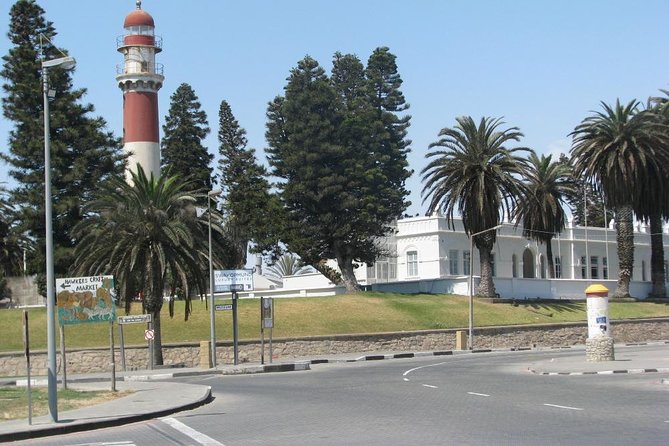
Swakopmund has a weird, wonderful superpower, it looks and feels German even though you’re deep in Namibia. This Historical Swakopmund city tour helps you connect the dots, from the trading powerhouse at the Woermannhaus to the Atlantic pounding the iron Swakopmund Jetty for decades. German Colonial architecture is the headline here, and the guide’s storytelling about why these buildings exist makes the town click fast.
You’ll spend about 2 hours on foot and at key monuments, and it stays focused on the historical center. If you want mostly indoor museums or wildlife, you might find this tour too centered on heritage architecture and monuments.
Key highlights of the Historical Swakopmund tour
- Woermannhaus fachwerkbau details explained, including the Damara Tower lookout and its role in early South West Africa trade
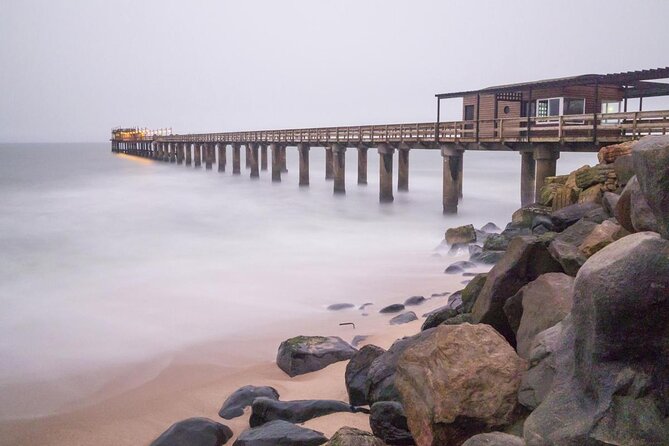
- The Swakopmund iron Jetty story told clearly, from the 1912 construction plan to the WWI-shortened length and long Atlantic durability
- Prinzessin-Rupprecht-Heim’s role changes over time, from military hospital to convalescent home and Red Cross renovations
- Haus Hohenzollern’s decorative German facade and why it looks so dramatic in desert light
- German Evangelical Lutheran Church background including Pastor Vedder’s open-air service story and Neo-Baroque planning
- Marine Memorial context with the First Marine Expedition dedication and the gunboat Panther link
Why Swakopmund feels like a German seaside town in the desert
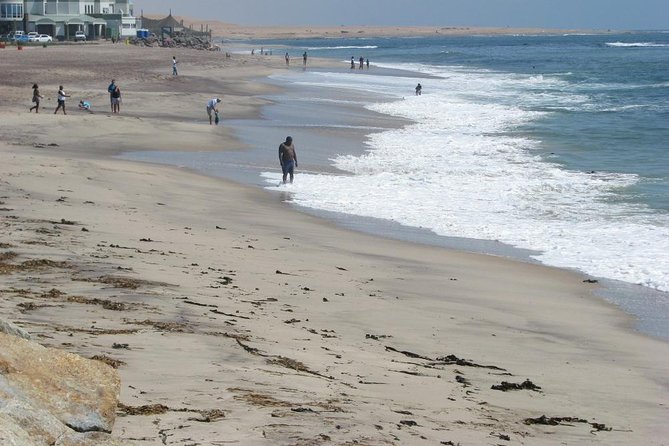
Swakopmund’s charm is not subtle. Founded in August 1892 by the German Colonial Reich, it grew into a prime holiday resort, but it was also a working port. For many years, it served as the main harbor for the territory, with the mole and later the jetty doing the heavy lifting. The payoff today is the town’s distinct German Colonial character, preserved enough that you can read the past in the streets.
This tour leans into that feeling. You’re not just seeing buildings, you’re learning what they were built for, who paid for them, and how the town’s coastal and trading importance shaped the architecture. Once you know the purpose behind the facade, the town becomes way easier to walk through.
Other ways to spend a day in Swakopmund
- Swakopmund Best Cultural Historical Township Tours Namibia
★ 5.0 · 8 reviews - Explorer Historical Private Township Cultural Tours
★ 4.0 · 6 reviews - Half Day Swakopmund Cultural Historical Township Tour
★ 5.0 · 4 reviews
Price, timing, and what you get for $37.16
At $37.16 per person for about 2 hours, the value is strongest if you’re trying to make your time count in Swakopmund. You’re paying for guided interpretation, not just walking past pretty corners. The tour also includes pickup offered and uses a mobile ticket, both of which remove friction when you’re on vacation.
A big practical plus is that the stops listed are marked admission ticket free. That matters, because a guided walking tour can quietly turn into a bill of small entry fees. Here, you can focus on the buildings and monuments themselves without the budget “nibbling” at you.
Meeting up at Swakopmund Museum and how the walk is paced
You start at Swakopmund Museum, Strand St (meeting point listed as 8GFF+Q62). The tour ends back at the same point, so you’re not forced into a long final return trek. Pickup is offered, which is a comfort benefit if you’re carrying beach gear or arriving from lodging outside the immediate core.
Group size caps at 25 travelers, which is the sweet spot for a historical city walk. Big enough to feel social, small enough that you’re not lost in a crowd. Confirmation is received at booking, and the meeting point is near public transportation, so you’re not dependent on one specific access plan.
The duration is “approx.”, so expect a relaxed pace rather than a sprint. You’ll pause often enough to look closely at details like gables, towers, and memorial sculptures, but you won’t be stuck for hours either.
Stop 1: Woermannhaus on Bismarck Street and the story of trade
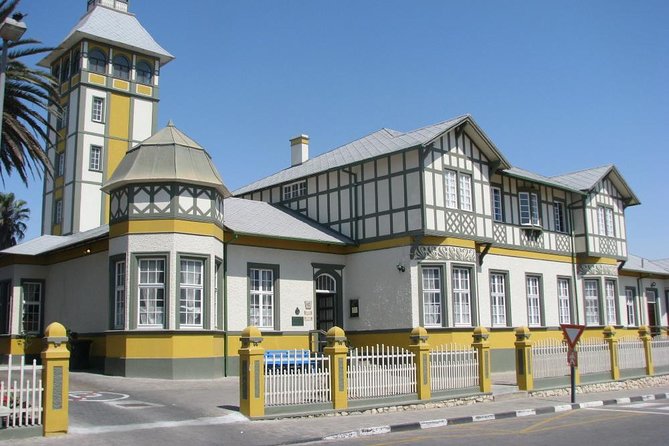
Woermannhaus is the kind of building that makes you want to slow down. It’s on Bismarck Street, and it’s a superb example of architect Friedrich Höft’s “Fachwerkbau” style, meaning you’re looking at that classic timber-framed look. If Swakopmund’s German vibe sometimes feels like set dressing from a movie, this is where it starts feeling real.
The essentials to notice are tied to the building’s job. It was erected in 1894 by the Damara and Namaqua Trading Company, then extended in 1903 and 1904 when wood-panelled offices were added. That courtyard once held an evergreen garden, which is a small detail but a useful one. It tells you the space wasn’t only for commerce, it was also a workplace with an inner life.
This is also where the tour’s “why” matters. Woermannhaus served as headquarters for the leading trading company in then South West Africa, later known as Woermann, Brock & Co. In 1909, it also housed selected officials and employees. Even the Damara Tower in the north-west corner becomes meaningful, because it wasn’t just decorative. It acted as a lofty lookout, served as a flag-mast, and functioned as a navigation point.
Practical tip: this is one of your best photo stops. When you’re standing in the street, take a moment to look up and map the tower and roofline. You’ll “read” the building better once you know what it was used for.
More trips out of Swakopmund:
- Walvis Bay: Marine Big 5 Luxury Catamaran Tour
★ 4.8 · 1,012 reviews - Swakopmund: Desert Dunes Quad Biking with Optional Sandboard
★ 4.9 · 590 reviews - Walvis Bay and Sandwich Harbour Tour
★ 4.8 · 483 reviews - Scenic Sandwich Harbour Tour
★ 5.0 · 277 reviews
Stop 2: The iron Swakopmund Jetty and the hard engineering of the coast
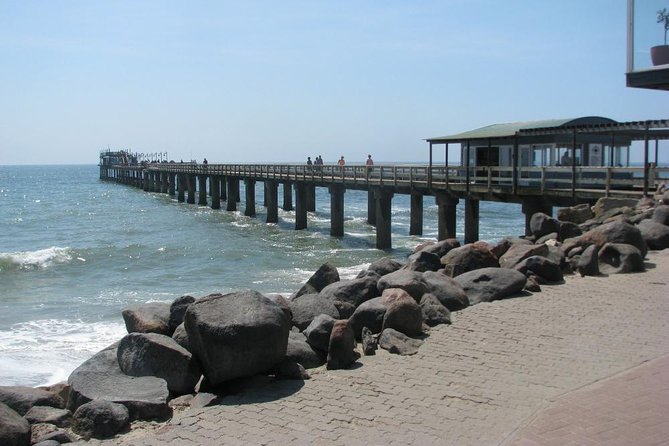
If Woermannhaus is about inland power, the Swakopmund Jetty is about the ocean’s pull. The jetty is an iron structure built in 1912 to replace a wooden jetty that had become derelict. Two firms based in Mannheim, Germany won the contract, and the original plan aimed for a 640 meter jetty.
Here’s where the coast gets its say. The rocky area made construction difficult enough that the company had to develop and incorporate a drilling program to overcome obstacles. Then WWI hit, and the project was left uncompleted, with the jetty extended only to 262 meters.
Now comes the impressive part: the jetty was built to such high standards that it endured the Atlantic for over 70 years, requiring little or no repair. You can practically feel the point of the tour here. This isn’t just “German architecture,” it’s German engineering meeting tough conditions and surviving long enough for Swakopmund to keep functioning.
Practical tip: this stop can feel windy, because the jetty puts you right where the weather likes to show off. Dress for that, and don’t be surprised if your photos look better when you hold your camera steady and shoot slower.
Stop 3: Prinzessin-Rupprecht-Heim, from military hospital to Red Cross care
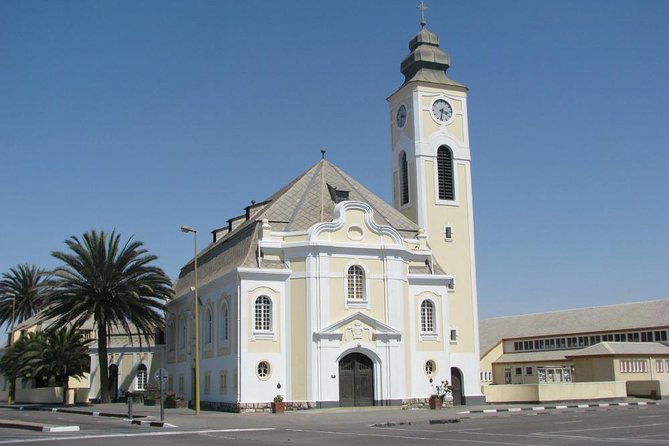
Next is Prinzessin-Rupprecht-Heim, a building that looks grand today and had serious responsibilities in its earlier life. Built in 1902, it was named after the patroness of the Bavarian Association and wife of the heir to the Bavarian throne, Prinzessin Rupprecht.
The story starts with function. Originally, it was built as a military hospital and was occupied in 1902. In 1909, the hospital closed and was converted into a convalescent home in 1911. Then two years later, the Bavarian Women’s Association of the Red Cross took over and commissioned extensive renovations with a donation of 35,000 mark.
Why this stop is worth your attention: it shows how European institutions moved, adapted, and re-purposed buildings in this part of the world. It’s easy to look at a pretty facade and stop there. This building forces you to look at the human side of the past.
Also, it’s a reminder that Swakopmund’s “German identity” wasn’t only about business and style. It included healthcare and organized relief efforts tied to early colonial-era networks.
Practical tip: this is a stop where a few careful minutes pay off. Look for the shape, entry rhythm, and overall symmetry. Then let the history make the architecture feel more intentional.
Stop 4: Haus Hohenzollern’s decorations and desert-proof German style
Hohenzollernhaus (Haus Hohenzollern) is built between 1904 and 1906, and it’s described as a former hotel with truly striking ornamentation. When you see it, you understand why it gets singled out.
The facade includes cupid and flower adornments, a corner pediment edged with two lions, and an imperial image of Atlas holding the world on his shoulders. Those are not small details. They’re big symbolic choices, meant to project power, culture, and prestige.
What’s clever here is the contrast. Even though Swakopmund sits in an area marked by the harshness of the Namib Desert, these pioneers constructed buildings with lasting visual impact. The point for you is not that the desert is “hard.” The point is that the builders were aiming for endurance and identity, not temporary decoration.
Practical tip: aim your attention at the corners. The lions and pediment edge are easiest to notice when you’re standing where two sides of the building meet the street.
Stop 5: The German Evangelical Lutheran Church and Pastor Vedder’s folded sermon
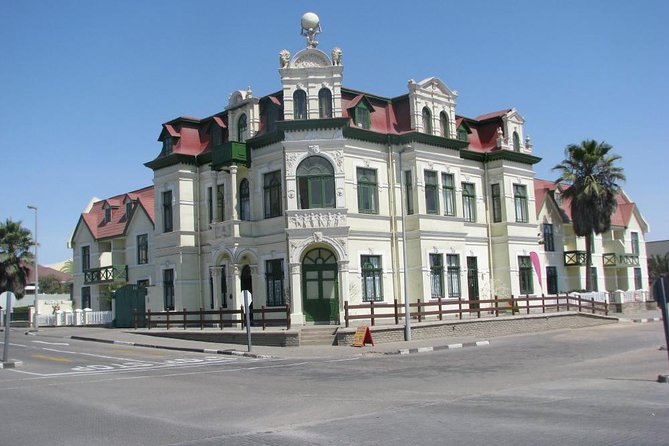
The German Evangelical Lutheran Church, along with its adjacent parsonage, brings religion into the story in a very human way. You also get a rare kind of origin tale, the sort that helps you remember details.
There’s a rumor that in 1905, Pastor Vedder was disappointed to find open-air church services completely unattended. He reportedly returned home to a wooden crate without roof, doors, or windows, with his sermon still neatly folded and unread. It’s the kind of story that sounds almost too dramatic, but it’s exactly the kind of anecdote that makes history feel alive.
By 1909, the congregation rallied around building plans. Architect Ertl drew up designs in the Neo-Baroque style, and the contract for building the church went to F. H. Schmidt in 1910, with a cost of 85,000 mark. The church bells were cast by Franz Schilling in Apolda, Germany, and the plan included three bells.
This stop matters because it shows how communities translated belief into built space, then kept refining what that space would become. It also adds variety to the walk. Trading company headquarters, maritime engineering, healthcare repurposing, luxury hotel symbolism, then a church with a design language all its own.
Practical tip: don’t rush this one. Neo-Baroque can be visually busy, so pick one focal element, then look outward from there.
Stop 6: Marine Memorial, the Panther gunboat, and why it became a national monument
The tour ends with the Marine Memorial, dedicated to members of Germany’s First Marine Expedition who were killed in action. The sculpture shows a marine standing beside his fallen comrade, designed by Berlin sculptor A. M. Wolff and cast by Gladenbeck A. G., Berlin.
The backstory is the kind of detail that makes monuments more than “a statue.” The crew of the gunboat Panther presented the memorial to the town of Swakopmund on 26 July 1908, on behalf of the Marine Infantry. Later, in 1969, the National Monuments Commission declared the Marine Denkmal a National Monument on 2 January 1969.
This is the emotional shift of the tour. Up to this point, you’ve been learning about commerce, construction, architecture, and community life. At the memorial, the focus becomes remembrance tied to a specific expedition and confirmed by formal monument status.
Practical tip: if you care about photography, this is a good place to slow down and look before shooting. You’ll get more from the meaning when you give the scene a full minute.
What makes the guide style work, especially with Hans-Dieter
One of the biggest reasons this tour earns a 5-star reputation is the guide. Hans-Dieter is described as prompt, clear, and full of concrete historical tidbits, and he brings family connection to the story, with grandparents who migrated from Germany and lived here. That kind of personal link often turns “facts” into something you can remember later.
I like tours where the guide helps you understand patterns. Here, the pattern is how Swakopmund’s harbor importance shaped its institutions and architecture. Once the guide ties the Woermannhaus trade story to the jetty engineering and then to the memorial and church, the whole town reads like one connected chapter.
You also get practical reassurance from the experience design. The group limit, the short time on each stop, and the free admission at stops all help you stay focused on the walking and the learning, not logistics stress.
How to make the most of the walk (and avoid the common annoyances)
This is a walking-and-looking tour, so comfort is your best friend. Wear shoes you’re happy standing in for short periods, because the value is in the details. You’ll be stopping repeatedly to view building facades and monuments, and some elements are easier to see from certain angles.
Also, arrive ready to look up. The Woermannhaus tower, the decorated Hohenzollernhaus corners, and church design details all reward “standing still and scanning.” If you rush at street level, you’ll miss the points that make this tour feel special.
If you’re planning other activities the same day, keep the rest lighter. Two hours is manageable, but you’ll still want time afterward to wander with your new mental map, especially around the historical center.
Who should book this Historical Swakopmund city tour
You’ll like this tour if:
- You’re new to Swakopmund and want quick orientation in the historical core
- You enjoy German Colonial architecture and want context, not just labels on plaques
- You want stories that connect trade, community life, and monuments into one clear narrative
- You prefer a small group experience capped at 25 people
You might skip it if:
- Your main goal is beach time, fishing, or nature activities, since the emphasis stays on historic buildings and memorials
- You hate walking or standing around to look at facades for a while
Should you book the Historical Swakopmund city tour?
If you have even a short window in Swakopmund, this is one of the smartest ways to spend it. The price is reasonable for a guided 2-hour circuit, the stops are admission free, and the history is delivered in a way that helps you actually see the town instead of just passing through it.
Book it especially if you want that satisfying moment when you stop thinking Swakopmund is just a “German-looking town” and start understanding why it developed the way it did.
If your schedule is tight, add this to your first day. You’ll walk the next streets with a much clearer sense of what you’re looking at, and you’ll waste less time guessing.
FAQ
What is the duration of the Historical Swakopmund city tour?
The tour is listed as approximately 2 hours.
Where does the tour start?
The meeting point is Swakopmund Museum on Strand St, listed as 8GFF+Q62.
Does the tour offer pickup?
Yes, pickup is offered.
Is there a mobile ticket?
Yes, the tour uses a mobile ticket.
What stops and highlights are included?
The tour includes Woermannhaus, Swakopmund Jetty, Prinzessin Rupprecht B&B (Prinzessin-Rupprecht-Heim), Hohenzollernhaus (Haus Hohenzollern), the German Evangelical Lutheran Church with parsonage, and the Marine Memorial.
Are there admission fees at the stops?
The stops are listed with admission ticket free.
How large is the group?
The maximum group size is 25 travelers.
When will I receive confirmation?
Confirmation is received at the time of booking.
Is this tour close to public transportation?
Yes, it is listed as near public transportation.
What is the cancellation policy?
Free cancellation is available, and you can cancel up to 24 hours in advance for a full refund. The experience requires a minimum number of travelers, and if it is canceled because the minimum isn’t met, you’ll be offered a different date or a full refund.
Latest reviews from Swakopmund
- Spitzkoppe – Day Tour to the Spitzkoppe Mountain from Swakopmund★ 5.0 · 3 reviews
- Unforgettable Half Day Adventure, Explore Sandwich Harbour★ 5.0 · 3 reviews
- Walvis Bay Shore Excursion: Flamingos, Dune 7, Swakopmund★ 5.0 · 3 reviews
- Half Day Swakopmund Cultural Historical Township Tour★ 5.0 · 4 reviews
- Full-Day Tour in Namib Desert from Swakopmund, Namibia★ 5.0 · 3 reviews
- Walvisbay Dune 7 and Swakopmund Town Half Day Guided Tour★ 4.0 · 4 reviews
- Swakopmund Cultural Township Private Day Tour★ 3.8 · 4 reviews
- Swakopmund Explorer Township Tour in Mondesa with Nande the Township Local Guide★ 5.0 · 4 reviews
City Tours, compared.

Half-Day Windhoek City and Township Cultural Tour
Read our review →

swakopmund city tour dune 7 pink lake pink flamingos
Read our review →

Walvisbay & Coastal Town City Private Local Guided Day Tour for Cruise Ships
Read our review →
Browse the lists this tour appears in