
Reviewed · NAMIB DESERT TOURS
Cruise liner Special: Swakopmund and Namib Desert Highlights
This is one of those Namibia day tours that works because it stitches together two very different worlds. You start on the Walvis Bay coast, then you head north into Swakopmund and out across the Namib Desert to see geology, desert plants, and big-sky views in one nonstop sweep.
I really like how the tour builds in small, meaningful stops instead of only big photo moments. The lichen field teaches how life works in this harsh place, and the Welwitschia plains show you a plant that has been adapting for ages, including the fog-fuel strategy that makes this landscape possible.
The one drawback to plan for is simple: it is a long day with a lot of driving. This can feel like too much seat time, and you will not have the option to take your own pace at every viewpoint. If you get restless in cars, pack snacks, water, and a book or download offline music.
Key Highlights You’ll Actually Feel That Day

- Cruise-friendly timing with pickup windows aligned to ship arrival, and waiting if the ship docks late
- Swakopmund jetty and colonial streets for a quick feel of German-era coastal life
- Fog-focused desert botany at the Welwitschia plains, including how male and female plants are pollinated
- Moonlandscape geology with visible traces of lava flow periods and ice ages
- Goanikontes watering-hole history where water shaped settlement, policing, and farming
- Walvis Bay Lagoon birdlife with massive flamingo numbers, plus pelicans, terns, and cormorants sometimes
A Cruise-Timed Day Trip That Doesn’t Forget Your Ship
This tour is designed for cruise liner schedules, which matters in Namibia because distances can eat time fast. Pickup is offered, and the timing is structured around when your ship arrives. If your ship docks late, the team will wait for you to disembark, so you are not stuck watching your excursion leave without you.
The format is also practical for first-time visitors: you get a full “coastal to desert” sampler in about 7 hours 30 minutes. The group size caps at 25 people, so you should not feel swallowed by a giant busload, though it is still a shared tour, not a private van.
One more logistics note that affects comfort and expectations: it is not private. If you want a private tour, you must pay for extra seats in the vehicle locally, which means this is still a fixed vehicle setup for most bookings.
More of the Namib:
- Namib Desert Landscape Tour
★ 5.0 · 20 reviews - Cruise liner special: Swakopmund and Namib Desert Highlight Tour
★ 4.5 · 5 reviews - NAMIB DESERT TOURS, Full-Day and Half-Day Tours from Swakopmund, Namibia
★ 5.0 · 11 reviews
From Walvis Bay Port to Swakopmund, With Desert Road Energy Already Kicking In
You start at Walvis Bay Port (the meeting point is listed as Walvis Bay Port2FWR+CFH, Unnamed Road). From there, you drive north toward Swakopmund, with a quick scenic bonus along the way.
One detail worth noticing is the route passes Bird Island, described as the only manmade guano island. It is the kind of stop you do not spend hours at, but it gives context for how this region has been shaped by bird life and harvesting over time.
Then you reach Swakopmund and shift gears into the coastal side of the day. This is helpful because it prevents the tour from feeling like you land in Namibia and immediately only see sand and rocks.
Swakopmund Jetty and Mole Walk: Quick, Old-World, and Easy
Stop one is the Swakopmund Jetty, plus the Mole area. This is a relaxed walking segment where you can stretch after the drive and orient yourself with the town’s older feel.
You also get a rundown of the history of this small German colonial town. You will see old buildings as you walk around, and the time is about one hour. Admission for this part is free, so it is basically free atmosphere with a short guide-led context.
What I like about this kind of opening stop is that it stops the day from becoming purely “look, photo, next.” You start to understand why the coast matters here, before you head inland to places where water is the main character.
Swakopmund’s Old Bones to the Namib Gravel Plains
As you drive through Swakopmund, you look at older hotels and stations from the road. Then the day tilts sharply toward desert conditions as the route heads onto gravel plains.
This transition is where people usually decide if they are “desert people” or “just passing through.” You go from coastal buildings to open terrain fast, so if you are sensitive to sun or cold, you will want to be prepared immediately after the town segment.
Other ways to spend a day in Walvis Bay
- Sandwich Harbour Scenic Excursion – Design for the Cruise Ships
★ 5.0 · 57 reviews - Mola Mola Marine Dolphin Cruise from the Walvis Bay Waterfront to Pelican Point
★ 5.0 · 52 reviews - Marine Dolphin Seal Cruise
★ 5.0 · 34 reviews - Walvis Bay: Namibian Coast Dolphin Cruise with Light Lunch
★ 4.8 · 20 reviews
Lichen Field Stop: The Tiny Partnership That Explains Survival
At the next major stop, you reach the Lichen field. This tiny plant is described as a joint venture between a mushroom and an algae, which is a great example of how survival here is not about one organism doing all the work.
The practical value is that you leave this stop understanding a key idea for the whole day. In the Namib, nature often uses partnerships and clever moisture capture, not lush growth. Admission here is included, and the time is about one hour.
If you like science stories that still feel human and visual, this is one of the best places to focus your attention. A lot of desert tours just point and move on. This one gives you a reason to look at something small that you could easily miss.
Moon Landscape Viewpoints 4: Lava, Ice, and the Feeling of Another Planet
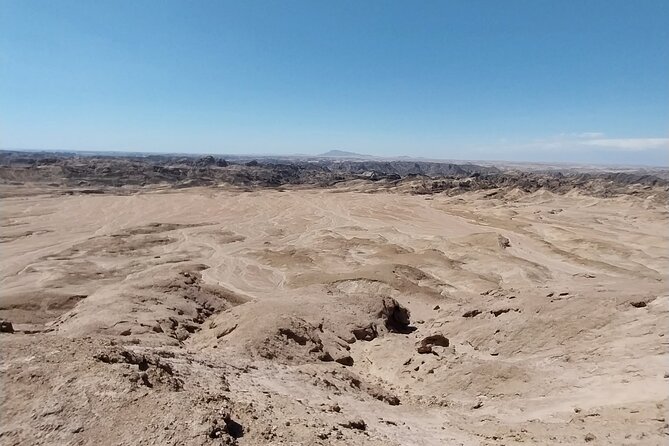
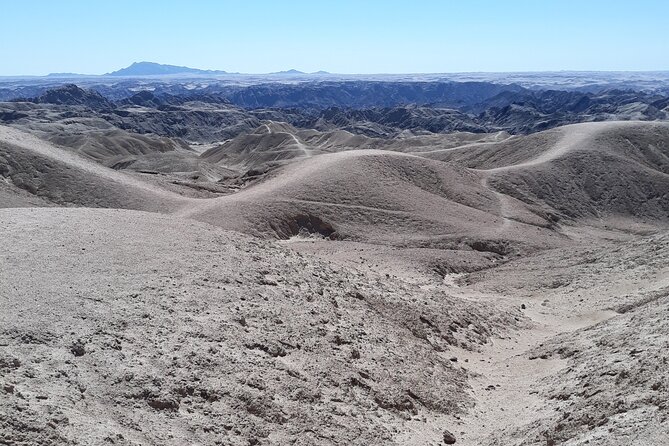
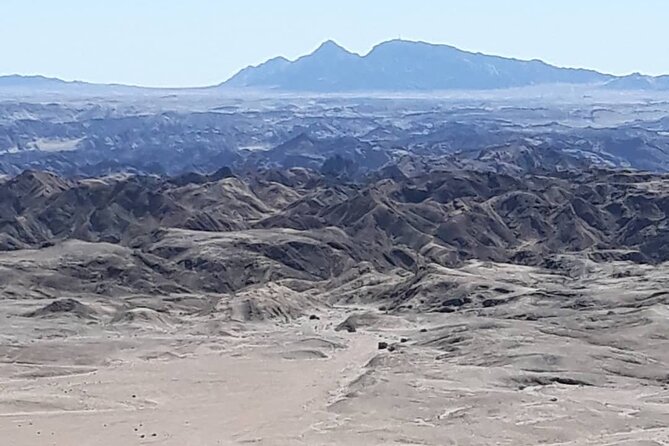
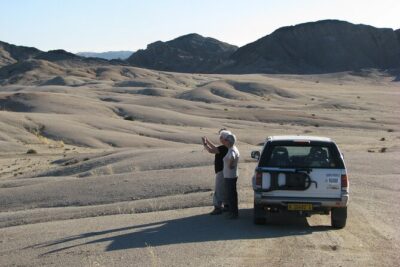
Then you hit the Moon Landscape viewpoints. The route uses gravel roads to reach spots along the moonlike terrain, with the guide pointing out traces of lava flow periods and ice ages.
This stop is where the Namib goes full sci-fi. You can genuinely feel like you are on another planet while walking among hard textures and stark forms. You also get mention of uranium exploration sites, which adds a human layer to the geology, showing that people have been reading this ground for resources too.
The tour allows about one hour here, and admission is included. You might also see desert animals such as zebra or springbuck, but the key word is might. You should treat it as an added bonus, not a promise.
Goanikontes: The Oasis That Shaped Water, Policing, and Farming
Next is Goanikontes, described as an oasis in the Swakopmund River. This is a stop with strong historical meaning because the riverbed here used to be a lifeline.
The guide context includes that it was the first watering hole from Swakopmund into the desert. You also pass an old police post area, and the site where vegetables were grown.
The practical reason this stop matters is that it turns the desert from a blank space into a route system. Where water appeared, people could move, settle, and enforce order. Admission for this stop is free, and the time is about one hour.
If you enjoy historical context tied to physical geography, this is the kind of stop that makes the whole day click.
Welwitschia Plains: The Fog-Fed Plant That Can Live for Centuries
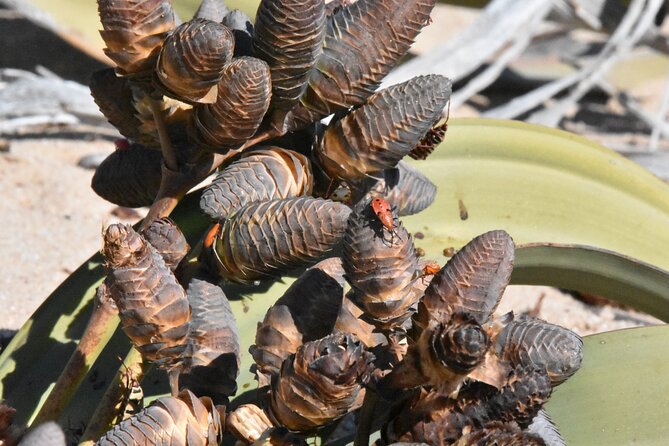
The highlight for many people is the Welwitschia plains stop. Even if you have heard of Welwitschia before, being there in the hard gravel setting helps you understand why it looks so strange: it has no stem, only two leaves.
The tour explains that Welwitschia has adapted to absorb moisture from the fog and the little rain that does fall. The timing of this stop is about two hours, and admission is included.
This is also where you get the most fascinating reproduction details for a plant that appears so minimal at first glance. The guide notes there are male and female plants, pollinated by tiny brown and orange bugs that live in and around the plant. Welwitschia produces thousands of seeds spread by the harsh prevailing winds.
This stop works well for different travel styles. If you like photos, you will get close visual interest. If you like learning, it is one of the few desert stops where the explanation is tightly tied to how the organism survives.
Dune 7 Viewpoint: You See It, You Do Not Climb It
After more desert driving, the tour passes Dune 7 close to Walvis Bay. You do get a viewing moment, and the time is about one hour for this segment.
Important expectation setting: you do not climb Dune 7. Admission is also listed as not included for this stop.
This is worth understanding before you go. If you were hoping for a “let’s hike a dune” experience, this tour is more about viewpoints and desert geology than summit-style activity. It still gives you the visual payoff of a landmark dune near Walvis Bay, but you keep your feet on the ground for the rest of the day.
Walvis Bay Lagoon Flamingos: Big Numbers, Fast Looks
You end with a stop at the Walvis Bay Lagoon to see flamingos. This short finale is about 15 minutes and admission is free.
The bird numbers provided are huge: more than 750,000 birds across 54 bird species, including palearctic migratory birds. You might also see pelicans, terns, and cormorants at times from the viewing areas.
This is a good end cap because it is a change from plants and rocks. It also helps you remember why this whole coast-to-desert trip makes sense. Namibia’s desert is harsh, but the coast is alive with movement and birds.
Price and Value for a 7.5-Hour Namibia Sampler
At $193.68 per person, this is not a budget throwaway. But for a cruise-focused, one-day route that covers Swakopmund plus multiple desert stops, it can represent solid value, especially if you are short on time in the region.
Here is the value angle I use to judge trips like this:
- You are paying for transportation over distances plus multiple guided context stops, not just entrance fees.
- Several key science and nature stops are included (like the lichen field, moon landscape, and Welwitschia plains), which reduces the “surprise costs” feeling.
- The flamingo stop and jetty walk are free, which keeps costs and time aligned.
The tradeoff is that you are buying breadth over depth. You get a taste of a lot, not a long sit-down at any single place. If you are the type who hates driving, the day might feel expensive for how much time you spend in a vehicle.
Guides, Language, and Crowd Avoidance That Actually Matter
The operator note says German-speaking guides are scarce. They are allocated on a first come, first served basis, and there is no guarantee, especially in peak season or when large cruise groups, such as about 2000 disembarking passengers, are in the harbour.
So go into this knowing you might hear English, German, or a mix. What helps is the guide-driven structure: stops are timed for how long you will actually be outside walking and viewing.
One practical advantage from past experiences is that guides may adjust timing to reduce crowd pressure at popular spots. That is a big quality difference on cruise days, because so many excursions show up at the same time.
In at least one set of German-language experiences, a guide named Hannes was praised for looking after the group well and helping keep the day moving without big crowds.
What to Expect on the Ground, Stop by Stop
Here is how the day usually feels from a participant perspective, not as a checklist but as a flow:
- Start calm in Swakopmund with a jetty and historical walking that does not demand much effort.
- Shift quickly to desert learning, first at the lichen field where the explanation helps you spot life in unlikely places.
- Go big and strange in the Moon Landscape, where you are walking on hard, planet-like ground and learning how geology can look like storytelling.
- Pause at Goanikontes to remember that water guided people across the desert route.
- Spend longer at Welwitschia plains, the best chance for real learning time and close-up observation.
- Finish with flamingos, a fast and exciting burst of movement and color at the lagoon viewing areas.
The biggest variable across departure days is how long the driving stretches feel to you. With a tour maximum of 25 people, it should not be chaotic, but it is still one route with fixed stop durations.
Practical Tips That Make This Day Easier
Because the day is a mix of town walking and outdoor desert viewpoints, I recommend planning for sun and wind. Bring:
- Sunscreen and a hat for the open viewpoint times
- Water (you will be outside for hours, and desert thirst comes fast)
- Comfortable shoes, even though most walking is short
- A camera with a charged battery, since moonlike terrain and Welwitschia are photogenic
For language, if German matters to you, assume you can request it but cannot treat it as guaranteed. The tour itself is structured to work even if you only understand part of the narration, because the visuals are strong at every stop.
Should You Book This Swakopmund and Namib Desert Highlights Tour?
I would book this if:
- You are a cruise liner visitor with limited time and you want a “big picture” day that connects coast history to desert nature.
- You enjoy learning on your feet, especially the science angle at lichen and Welwitschia.
- You want a well-filled day, not a slow, wandering half day.
I would think twice if:
- You hate long car rides and want a lighter schedule. This is a single-day sweep with lots of seat time.
- You specifically want hiking or climbing challenges, because you will not climb Dune 7.
If you are on the fence, the deciding factor is your tolerance for driving versus your desire to see multiple desert highlights in one run. If you can handle a long day in exchange for an efficient Namibia intro, this is a strong match.
FAQ
How long is the Special Swakopmund and Namib Desert Highlights tour?
The tour runs about 7 hours 30 minutes (approx.).
Where does the tour start and where does it end?
It starts at Walvis Bay Port (listed as Walvis Bay Port2FWR+CFH, Unnamed Road) and ends back at the same meeting point.
Is pickup included?
Yes, pickup is offered.
Is this a private tour?
No. It is not private. If you want a private tour, you need to pay for extra seats locally.
What is the group size limit?
The tour has a maximum of 25 travelers.
Do I need a printed ticket?
No, the tour uses a mobile ticket.
Which stops are included during the day?
You’ll visit Swakopmund Jetty, Swakopmund Hotel and Entertainment Centre area, Moon Landscape viewpoints, Goanikontes, Welwitschia Plains, Dune 7 (view only), and a stop at the Walvis Bay Lagoon for flamingos.
Are entrance fees included for the stops?
Some stops are included, such as the Lichen field, Moon Landscape viewpoints, and Welwitschia plains. Other stops like the Swakopmund jetty walk and Goanikontes are free. Dune 7 admission is listed as not included.
Do you climb Dune 7?
No. You view Dune 7 but do not climb it.
Will the guide wait if my cruise ship docks late?
Yes. If the ship dock late, the team will wait for you to disembark.
Latest reviews from Walvis Bay
- Walvis Bay: Seal Kayaking Adventure with Brunch★ 4.1 · 3 reviews
- Mola Mola Marine Dolphin Cruise & Beach Braai on Pelican Point★ 5.0 · 3 reviews
- Full Day Tour Shipwreck Sandwich Harbour Adventure★ 5.0 · 3 reviews
- Swakop River Valley & Spitzkoppe Full Day 4×4 tour from Walvis Bay★ 5.0 · 3 reviews
- Sandwhich Harbour Dune 4×4 Full Day★ 4.0 · 3 reviews
- Mola Mola Kayaking Experience with a Licensed Guide★ 5.0 · 4 reviews
- Wildlife and Landscape Tour- full-day (7hours) from Walvis Bay★ 5.0 · 5 reviews
- Sandwich Harbour Sunset Photography Tour★ 5.0 · 6 reviews
Namib Desert Tours, compared.
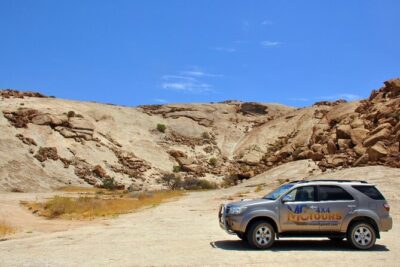
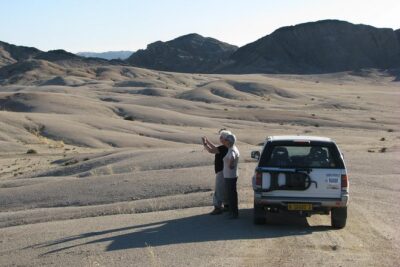
NAMIB DESERT TOURS, Full-Day and Half-Day Tours from Swakopmund, Namibia
Read our review →Cruise liner special: Swakopmund and Namib Desert Highlight Tour
Read our review →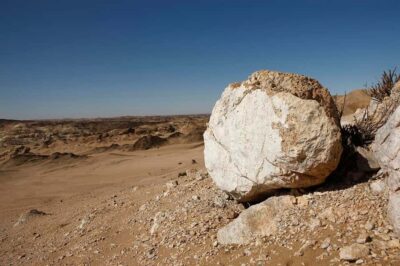
Full-Day Tour in Namib Desert from Swakopmund, Namibia
Read our review →Browse the lists this tour appears in